REVIEW Insight
Breaking Welcome to Review Insight Center. Stay updated with the latest headlines and articles!

Latest News

News Image

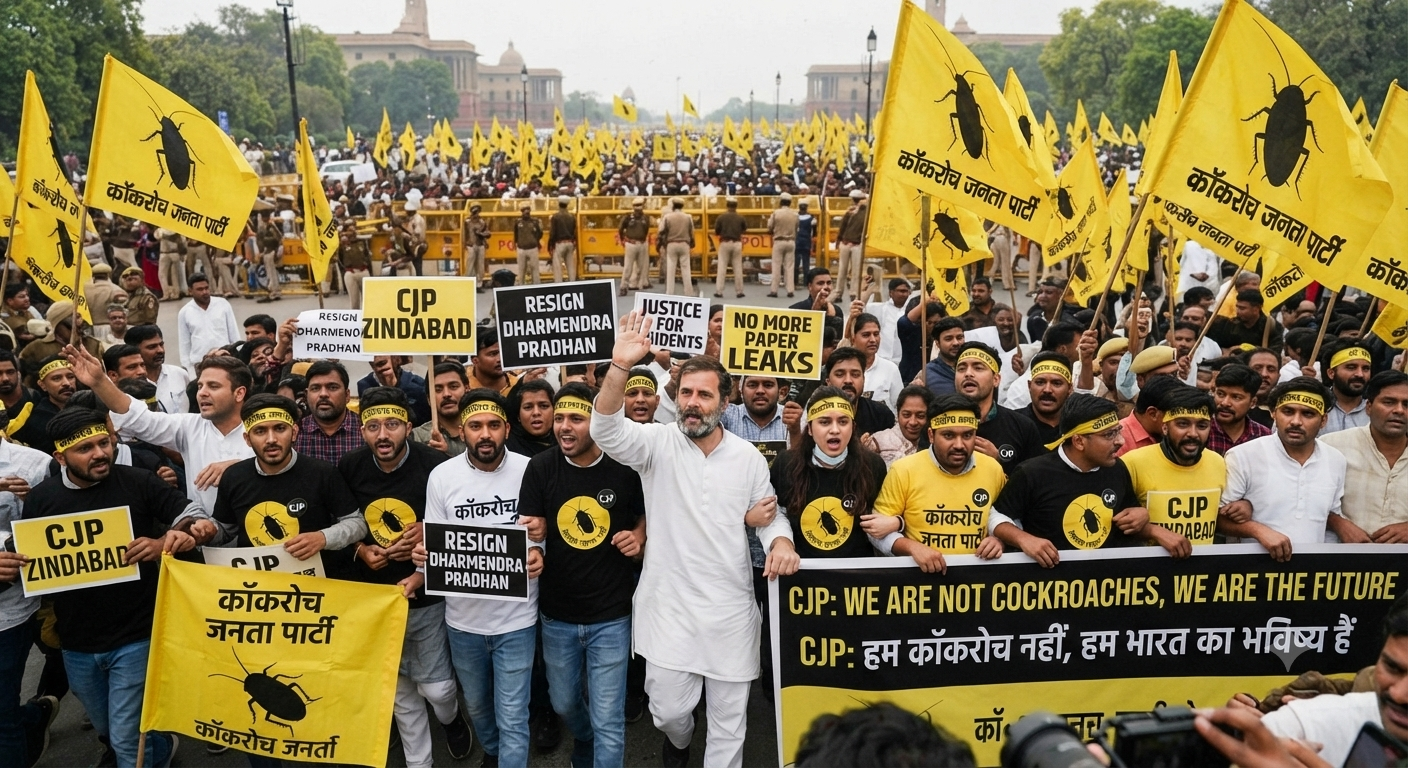
Opposition MPs Disrupt Indian Parliament in Support of "Cockroach" Protesters

Tensions reached a boiling point in the Indian parliament as opposition lawmakers fiercely disrupted proceedings. The legislative disruption came in direct solidarity with the youth-led "Cockroach Janta Party" (CJP) movement and in sharp condemnation of the heavy-handed police crackdown against student demonstrators in New Delhi. Outrage Over Police Crackdown The parliamentary chaos follows mass demonstrations where tens of thousands of young protesters marched toward parliament to demand the resignation of Education Minister Dharmendra Pradhan. The demonstrations were sparked by widespread outrage over recurring high-stakes medical entrance exam paper leaks and systemic failures within India's education sector. Security forces met the marching crowds with heavy barricades, tear gas, and baton charges, injuring dozens of protesters and security personnel. The aggressive police response drew immediate, fierce backlash from opposition leaders. High-profile politicians—including senior members of the Congress party—condemned authorities for employing tear gas and physical force against students and children. A Growing Political Showdown The momentum of the CJP movement—which originated as a satirical online campaign following controversial judicial remarks comparing unemployed youth to "cockroaches"—has transformed into one of the most substantial grassroots challenges to Prime Minister Narendra Modi's government in recent years. By bringing their protest inside the halls of legislature, opposition MPs have amplified the demonstrators' core demands: the immediate resignation of the education minister, comprehensive examination reforms, and justice for students affected by the systemic leaks. As the standoff continues, the alliance between street-level youth activism and parliamentary disruption has set the stage for an intense political showdown.

News Image

A Legendary Career in Numbers

Renowned English referee Anthony Taylor has officially announced his retirement from elite refereeing following the conclusion of the 2026 FIFA World Cup, bringing an end to a distinguished career spanning more than two decades and 831 matches. The 47-year-old official bowed out from top-flight officiating after taking charge of his final high-profile fixture: the World Cup round-of-16 clash between Portugal and Spain. A Legendary Career in Numbers Over 16 seasons in the Premier League, Taylor established himself as one of England's most trusted and decorated referees, handling 432 top-flight matches. His domestic resume includes refereeing every major English cup final, featuring appointments to the FA Cup finals in 2017 and 2020, the 2015 League Cup final, the Community Shield, and the Championship play-off final. On the international stage, Taylor spent 14 years on the FIFA international list, overseeing 163 international fixtures. His major tournament assignments include: FIFA World Cups: 2022 and 2026 UEFA European Championships: EURO 2020 and EURO 2024 Showpiece Finals & Semi-finals: The 2021 UEFA Nations League final, the 2022 FIFA Club World Cup final, the 2023 UEFA Europa League final, and the 2024 UEFA Champions League semi-final. Citing Pressure and Constant Scrutiny Reflecting on his decision to step down, Taylor opened up about the grueling mental toll of officiating at the highest tier of professional football. "Officiating at the elite level has been an immense privilege, but the pressure is intense and the scrutiny is constant," Taylor said in a statement. "The time is now right to step aside and look forward to transitioning to the next chapter of my career." Howard Webb, Chief Refereeing Officer at Pro Ref, paid tribute to Taylor’s exceptional contributions, describing him as a fantastic servant to the game and a role model for the next generation of match officials.

News Image

What is Artificial Intelligence?

Artificial Intelligence (AI) is not just a buzzword; it's the technological force reshaping our world. From personalized recommendations on streaming services to life-saving diagnoses in hospitals, AI's influence is pervasive and growing. In this article, we explore the core concepts, applications, and ethical considerations of this transformative technology. What is Artificial Intelligence? At its simplest, AI refers to the simulation of human intelligence by machines, especially computer systems. These systems are designed to perform tasks that typically require human understanding, such as learning, reasoning, problem-solving, perception, and language comprehension. Unlike traditional software, which follows a set of explicit rules, modern AI (specifically machine learning) is trained on vast amounts of data to identify patterns and make decisions or predictions. The Evolution: From Automation to Intelligence The journey of AI began with simple automation—machines performing repetitive tasks. Today, it has evolved into sophisticated systems that can learn and adapt. Key drivers of this evolution include: Machine Learning (ML): A subset of AI where algorithms are not explicitly programmed but learn from data. The more data they process, the better they get at their specific task. Deep Learning: An advanced form of machine learning inspired by the structure of the human brain, using artificial neural networks to process complex data. Big Data: The massive volume of data generated daily, which fuels the training of AI models, enabling them to recognize intricate patterns. Real-World Applications AI is already integrated into numerous aspects of our lives: Healthcare: AI models are being used to analyze medical images (X-rays, MRIs) for early disease detection, assist in robotic surgeries, and personalize patient treatment plans. Transportation: Self-driving cars are perhaps the most famous example, but AI is also used in traffic management systems and logistics optimization. Finance: AI algorithms detect fraudulent transactions in real-time, power algorithmic trading, and provide personalized financial advice through robo-advisors. Customer Service: Chatbots and virtual assistants handle a wide range of customer inquiries, providing quick and efficient support. Entertainment: Platforms like Netflix and Spotify use AI to analyze user behavior and recommend content, creating personalized experiences. The Ethical Implications and Future Despite its benefits, AI presents significant ethical and societal challenges. Concerns include: Bias and Fairness: AI models trained on biased data can perpetuate and even amplify existing inequalities. Privacy: The widespread collection of data required for AI raises serious privacy concerns. Job Displacement: The automation of tasks by AI has the potential to displace workers across various industries, requiring reskilling and workforce adaptation. Looking to the future, the focus must be on developing "responsible AI." This involves ensuring transparency in how AI systems make decisions, implementing robust data governance, and creating ethical frameworks to guide their use. AI holds immense potential to solve complex global challenges, but its development must be guided by a commitment to human well-being and equity. Article Illustration: The Nexus of Human and Machine This image visualizes the concept of Artificial Intelligence, capturing the collaboration between human and machine. A human hand and an anthropomorphic robot hand are gently making contact, with their fingers intertwining. The robot hand is adorned with a glowing "AI" logo, symbolizing its nature. The background is a digital landscape of light trails, mathematical equations, neural network nodes, and glowing data streams, all converging towards the handshake. A small brain made of digital circuitry glows in the foreground. The overall color palette blends futuristic blues and purples with humanizing golds, illustrating the fusion of technology and human potential.

News Image

US Approves Landmark Civil Nuclear Agreement with Saudi Arabia, Opening Pathway for Domestic Uranium Enrichment

US Approves Landmark Civil Nuclear Agreement with Saudi Arabia, Opening Pathway for Domestic Uranium Enrichment The United States and Saudi Arabia have reached a major 30-year civil nuclear agreement that establishes a framework for American corporations to help build and develop the kingdom's civilian nuclear energy program. Key Highlights of the Agreement Uranium Enrichment Potential: The deal creates a potential pathway for Saudi Arabia to develop domestic uranium enrichment capabilities on its own soil, following a joint U.S.-Saudi feasibility study. Involvement of U.S. Firms: The arrangement is designed to position U.S. companies—such as legacy nuclear giant Westinghouse—at the forefront of constructing Saudi Arabia's nuclear sector while largely keeping out foreign competitors. Energy Needs: The civilian program is aimed at supplying massive energy requirements, particularly to support growing technological infrastructures like AI data centers, while helping the kingdom diversify its economy away from oil. Congressional Review and Global Safeguards The Trump administration is expected to officially submit the pact to Congress for review. While proponents emphasize that the deal strengthens bilateral economic and strategic ties and incorporates safeguards to block weapons-grade enrichment, the agreement has drawn scrutiny from non-proliferation experts. Critics note that the pact omits certain aggressive international inspection standards—such as the International Atomic Energy Agency's (IAEA) Additional Protocol—sparking debate among lawmakers regarding regional security and nuclear proliferation.

News Image

Dhurandhar Actor Ayesha Khan Detained by Mumbai Police During NEET Protests

Dhurandhar Actor Ayesha Khan Detained by Mumbai Police During Student Protests Actor Ayesha Khan, who recently gained widespread popularity for her appearance in the hit song "Shararat" from the film Dhurandhar, was detained by the Mumbai Police on July 22. She was taken into custody during student-led demonstrations held in solidarity with NEET aspirants and student demands for educational reforms and accountability. The Incident at Dadar According to Ayesha Khan, she arrived at the protest venue near Shivaji Park in Dadar around 4:00 PM to show support alongside her brother and friends. However, the situation escalated quickly when police intervened. Sharing her ordeal through a series of emotional videos on Instagram Stories, Ayesha claimed that she and her companions had not raised any slogans, displayed placards, or even started protesting. She stated that after her brother and male friends were forced into a police van, she and two other female friends were standing peacefully on the roadside when approximately 15 police personnel—including female officers—surrounded them and compelled them to enter the vehicle. "My hands are literally shivering right now. I've been detained in the police van just for standing on the road peacefully. I didn't say a word. I didn't even start the protest," Ayesha shared from inside the police van. Questioning the Detention The actor expressed deep frustration over the lack of communication from authorities, noting that officers failed to answer why she was being detained or what law she had broken. She and her friends were subsequently transported from Dadar to the Worli Police Station. While she noted that the personnel at the police station treated them politely, she strongly criticized the aggressive handling and pushing by officers at the protest site. Release from Custody Following hours of updates and widespread social media attention, Ayesha posted an update informing her followers that she had been released. She later headed to another station to secure the release of her brother, emphasizing that their group had been targeted and separated across different parts of the city despite "doing nothing wrong". The protests in Mumbai are part of wider demonstrations that originated in New Delhi—launched by the Cockroach Janata Party (CJP)—following widespread student discontent over examination irregularities, paper leaks, and systemic accountability.