Published on July 22, 2026, 8:11 pm
What is Artificial Intelligence?
Artificial Intelligence (AI) is not just a buzzword; it's the technological force reshaping our world. From personalized recommendations on streaming services to life-saving diagnoses in hospitals, AI's influence is pervasive and growing. In this article, we explore the core concepts, applications, and ethical considerations of this transformative technology.
What is Artificial Intelligence?
At its simplest, AI refers to the simulation of human intelligence by machines, especially computer systems. These systems are designed to perform tasks that typically require human understanding, such as learning, reasoning, problem-solving, perception, and language comprehension. Unlike traditional software, which follows a set of explicit rules, modern AI (specifically machine learning) is trained on vast amounts of data to identify patterns and make decisions or predictions.
The Evolution: From Automation to Intelligence
The journey of AI began with simple automation—machines performing repetitive tasks. Today, it has evolved into sophisticated systems that can learn and adapt. Key drivers of this evolution include:
Machine Learning (ML): A subset of AI where algorithms are not explicitly programmed but learn from data. The more data they process, the better they get at their specific task.
Deep Learning: An advanced form of machine learning inspired by the structure of the human brain, using artificial neural networks to process complex data.
Big Data: The massive volume of data generated daily, which fuels the training of AI models, enabling them to recognize intricate patterns.
Real-World Applications
AI is already integrated into numerous aspects of our lives:
Healthcare: AI models are being used to analyze medical images (X-rays, MRIs) for early disease detection, assist in robotic surgeries, and personalize patient treatment plans.
Transportation: Self-driving cars are perhaps the most famous example, but AI is also used in traffic management systems and logistics optimization.
Finance: AI algorithms detect fraudulent transactions in real-time, power algorithmic trading, and provide personalized financial advice through robo-advisors.
Customer Service: Chatbots and virtual assistants handle a wide range of customer inquiries, providing quick and efficient support.
Entertainment: Platforms like Netflix and Spotify use AI to analyze user behavior and recommend content, creating personalized experiences.
The Ethical Implications and Future
Despite its benefits, AI presents significant ethical and societal challenges. Concerns include:
Bias and Fairness: AI models trained on biased data can perpetuate and even amplify existing inequalities.
Privacy: The widespread collection of data required for AI raises serious privacy concerns.
Job Displacement: The automation of tasks by AI has the potential to displace workers across various industries, requiring reskilling and workforce adaptation.
Looking to the future, the focus must be on developing "responsible AI." This involves ensuring transparency in how AI systems make decisions, implementing robust data governance, and creating ethical frameworks to guide their use. AI holds immense potential to solve complex global challenges, but its development must be guided by a commitment to human well-being and equity.
Article Illustration: The Nexus of Human and Machine
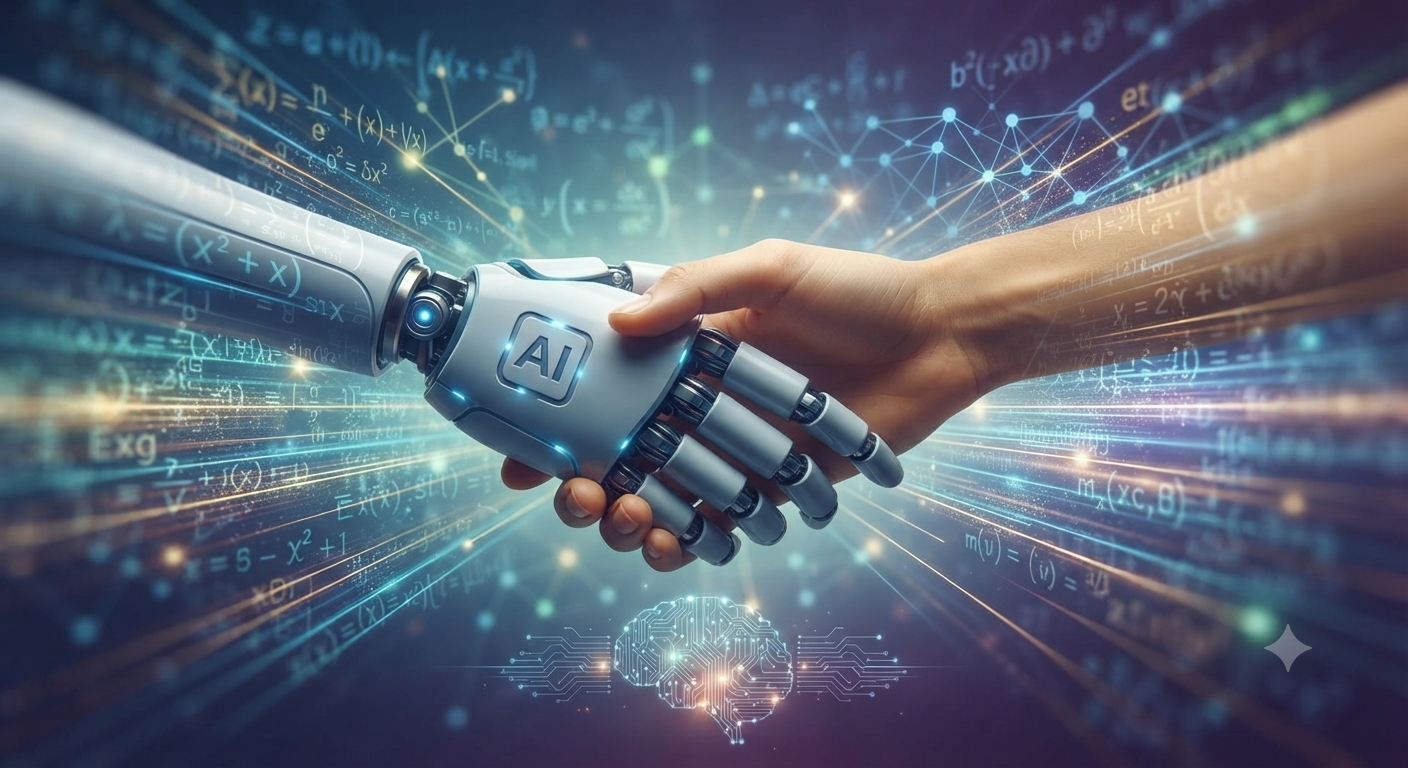
This image visualizes the concept of Artificial Intelligence, capturing the collaboration between human and machine. A human hand and an anthropomorphic robot hand are gently making contact, with their fingers intertwining. The robot hand is adorned with a glowing "AI" logo, symbolizing its nature. The background is a digital landscape of light trails, mathematical equations, neural network nodes, and glowing data streams, all converging towards the handshake. A small brain made of digital circuitry glows in the foreground. The overall color palette blends futuristic blues and purples with humanizing golds, illustrating the fusion of technology and human potential.
What is Artificial Intelligence?
At its simplest, AI refers to the simulation of human intelligence by machines, especially computer systems. These systems are designed to perform tasks that typically require human understanding, such as learning, reasoning, problem-solving, perception, and language comprehension. Unlike traditional software, which follows a set of explicit rules, modern AI (specifically machine learning) is trained on vast amounts of data to identify patterns and make decisions or predictions.
The Evolution: From Automation to Intelligence
The journey of AI began with simple automation—machines performing repetitive tasks. Today, it has evolved into sophisticated systems that can learn and adapt. Key drivers of this evolution include:
Machine Learning (ML): A subset of AI where algorithms are not explicitly programmed but learn from data. The more data they process, the better they get at their specific task.
Deep Learning: An advanced form of machine learning inspired by the structure of the human brain, using artificial neural networks to process complex data.
Big Data: The massive volume of data generated daily, which fuels the training of AI models, enabling them to recognize intricate patterns.
Real-World Applications
AI is already integrated into numerous aspects of our lives:
Healthcare: AI models are being used to analyze medical images (X-rays, MRIs) for early disease detection, assist in robotic surgeries, and personalize patient treatment plans.
Transportation: Self-driving cars are perhaps the most famous example, but AI is also used in traffic management systems and logistics optimization.
Finance: AI algorithms detect fraudulent transactions in real-time, power algorithmic trading, and provide personalized financial advice through robo-advisors.
Customer Service: Chatbots and virtual assistants handle a wide range of customer inquiries, providing quick and efficient support.
Entertainment: Platforms like Netflix and Spotify use AI to analyze user behavior and recommend content, creating personalized experiences.
The Ethical Implications and Future
Despite its benefits, AI presents significant ethical and societal challenges. Concerns include:
Bias and Fairness: AI models trained on biased data can perpetuate and even amplify existing inequalities.
Privacy: The widespread collection of data required for AI raises serious privacy concerns.
Job Displacement: The automation of tasks by AI has the potential to displace workers across various industries, requiring reskilling and workforce adaptation.
Looking to the future, the focus must be on developing "responsible AI." This involves ensuring transparency in how AI systems make decisions, implementing robust data governance, and creating ethical frameworks to guide their use. AI holds immense potential to solve complex global challenges, but its development must be guided by a commitment to human well-being and equity.
Article Illustration: The Nexus of Human and Machine
This image visualizes the concept of Artificial Intelligence, capturing the collaboration between human and machine. A human hand and an anthropomorphic robot hand are gently making contact, with their fingers intertwining. The robot hand is adorned with a glowing "AI" logo, symbolizing its nature. The background is a digital landscape of light trails, mathematical equations, neural network nodes, and glowing data streams, all converging towards the handshake. A small brain made of digital circuitry glows in the foreground. The overall color palette blends futuristic blues and purples with humanizing golds, illustrating the fusion of technology and human potential.
Comments (0)
No comments yet. Be the first one to comment!